
THE MIDDLE, TRANSFORMED
by Donald Maass
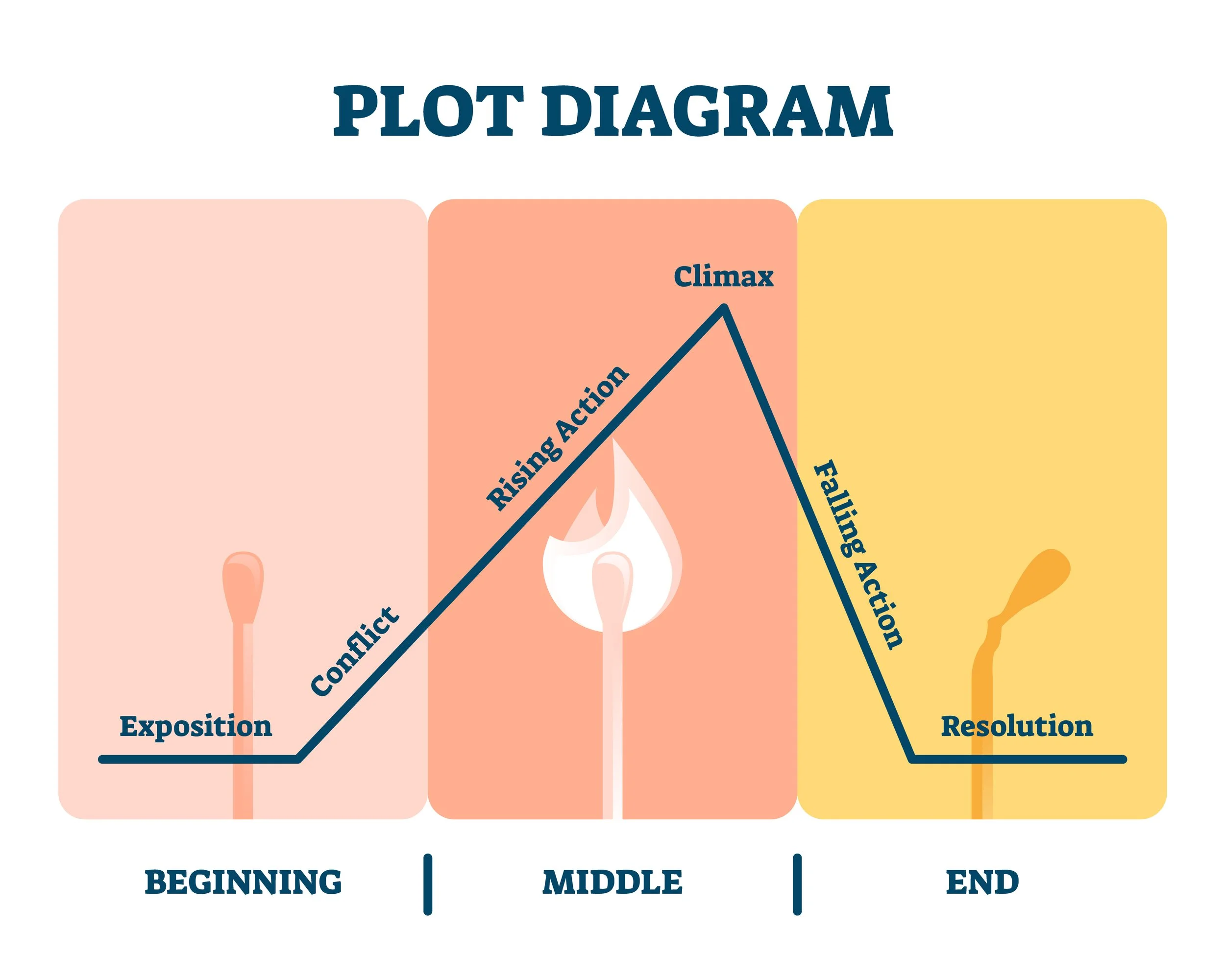
I notice it in many manuscripts: following the opening, a downshift in tension akin to a speed bump in the road. Momentum drops. The trudge of the middle begins.
Listen to authors and the middle is not a happy place to be. It’s described with words like morass, muddle, sagging, swamp. Characters get stuck. There’s a sense of slog, both in the writing and—sad to say—often in the reading. It’s sometimes a labor to come up with things to “happen”, which in turn can produce a feeling of routine. Story stuff gets done, but with lower drama.
Why does that occur? A primary culprit is the fallacy that a story is built out of a string of events. Cook up plot events. Keep stirring the pot. When a lot “happens” there’s a lot of story, yes? Rapid arrival of those happenings increases pace, true?
Not exactly. Events which we can visualize are part of what creates a story in the reader’s imagination, but that’s not all of it. The other major part is emotional cues, meaning not reported character emotions but for the reader points of familiarity: moments for which readers have analogous experience, dollops of recognition—ah-hah, yes, been there—which are how a story can vanish our surroundings and make us feel like we are actually present in a made-up world and that what is happening there is as if it happening to us.
(Those points of “connection”, BTW, are what editors are referring to in their rejection e-mails. I didn’t connect as much as I wanted to.)
In other words, if you look at the middle as what happens next, and next, and after that, and so on, then you are going to fill your pages with something more like a record, chronicle or diary. Not everything that can be set down is dramatic. Routine business is routine. The techniques of micro-tension can spark up anything but when a story is a more than all else a slave to time and visual events, there is bound to be slack.
Hence the drop off in momentum, tension and drama as we hit the middle. To counter-act that, it would seem that cutting out routine things and always jumping to the next big plot happening is the ticket. While not a wholly terrible idea, a race from bombshell to bombshell produces a thin reader experience. For proof, observe the mile-a-minute thrillers in remainder bins and at used book sales. Plot-plot-plot turns into plod-plod-plod.
To engineer an effective transition from opening to middle, I think there’s a better way to think about it. It starts with understanding what truly brings story alive in a reader’s imagination. That in turn, if you ask me, leads us inevitably to this redefinition of story structure:
There really is no such thing as the middle.
Away with the Middle
We have been told from the crib that a story is made up of a beginning, middle and end. But is that true? If a story is primarily what “happens”, then maybe so but we have seen how that fallacy leads to intrigue-dependent and only partially involving storytelling.
A deeper understanding is that story is built using scenes (or chapters, if that’s your preference) which in turn are units of change which are in turn again built of moments, which we can define as units of reader recognition and connection. Think atoms, molecules and matter. Think of every sentence as a heartbeat, every micro-step as a breath, every small momentary tension and turn –external or internal—as the momentum that sweeps us along, keeping the story alive, breathing and moving in our imaginations.
When you see story not as external events but rather as continual stimulation of the reader’s imagination, then there is no such thing as middle—or beginning or end, either. There is only a moment-by-moment involvement by the reader. Yes, things must “happen”. Yes, a story takes a character on an inner journey, hopefully. The deeper truth, though, is that story is not just one thing following another, it is one second following another. Each second—or in our terms a sentence, paragraph, a defined point in time, a trace of being, a “beat”—is what makes any page in a novel involving to read.
And when every page in a novel is worth reading, is there any slack? No, there is only a story continually flowing, always alive, always promising, always anticipating, always connecting. In making a phase transition, as to the “middle”, plot doesn’t matter. Connecting with readers over and over again does.
Making the Connection
That’s nice in theory but what does it mean in practical terms? How do you accomplish “connecting” page by page as you write so that there is never any fall off, no downshift, no sense of arriving “middle”? There are many ways to make reader connections at any moment in a novel, but for today let’s start with one.
Whatever your story is about, whatever it’s style or pace or purpose, there is one thing that can always be operative regardless of where or when we find ourselves: Something is changing.
Do you ever feel things changing? Of course you do. All the time. Right. That’s a sensation that we can connect to as we read. It is also something you can use as you transition from your fabulous opening strategy into the mechanical, working business of what we used to call the middle.
When I say “changing”, what I mean is not racing to the next plot event. As your opening closes and we step forward in the story, the next plot event is not necessarily close. Other things have to be covered. Tension and drama then typically drop off. But remember, tension doesn’t lie in what objectively “happens”. Tension is in the mind of the reader and when things are changing, we are slightly on edge.
In Holly Black’s fantasy The Cruel Prince (2018), our heroine Jude is, with her siblings, forcibly abducted from our world and taken to Faerieland, which their mother fled. After that violent prologue, Black has to settle us into Jude’s later existence, smoothly incorporating what we need to know. This is accomplished as Jude is dressed by an imp for a dance at the High King’s Court, which is to precede a coming—trope alert—tournament. Along comes Jude’s sister Taryn, who predicts that the evening ahead will be fun.
“Fun?” I’d been imagining myself frowning at the crowd from our usual bolt-hole and worrying over whether I’d to well enough in the tournament to impress one of the royal family into granting me knighthood. Just thinking about it makes me fidgety, yet I think about it constantly. My thumb brushes over the missing tip of my ring finger, my nervous tic.
“Yes,” she says, poking me in the side.
“Hey! Ow!” I scoot out of range. “What exactly does this plan entail?” Mostly when we go to Court, we hide ourselves away. We’ve watched some very interesting things, but from a distance.
She throws up her hands. “What do you mean, what does fun entail? It’s fun!”
I laugh a little nervously. “You have no idea, either, do you? Fine. Let’s go see if you have a gift for prophecy.”
We are getting older and things are changing. We are changing. And as eager as I am for it, I am also afraid.
What is pulling us forward in this utility passage from Chapter 2 of The Cruel Prince? There is Jude’s nervous tension. There is the question of why she is missing the tip of her ring finger. Even more, though, there is a sensation we can relate to: Jude and her siblings are growing up. They are changing. Their relationships are changing. And when change is in the air, we human readers know what that means: Things are going to happen.
A sense of change yields anticipation. Anticipation causes us to read on. When change is constant—when is it not?—story is moving.
There’s a bigger point, here: We may “see” in our minds’ eyes, but what maintains reader engagement is the constant arrival of what is new. New sets the reader brain working. Review—as in hand-wringing worry or back-story rerun—does the opposite. New versus review. New is better.
There’s a subtle example of this twenty-one pages into Kylie Lee Baker’s Japanese Gothic (2026). The story concerns Lee Turner, who has fled New York for his father’s new home in Japan. He doesn’t remember details of, or why he killed his roommate. After that arresting premise is dropped, Baker faces the humdrum, middle-ish task of filling in Lee’s relationship with his father, particularly his father’s history of girlfriends and the one who has stuck, named Hina:
But Hina never jumped when she turned and saw him in a doorway, never flinched at the coldness of his skin, never shrank away from the shadows in his eyes. She brought him pretty engraved silverware from yard sales and bright cuts of sea glass and old marbles, like she thought he was some sort of corvid drawn to shiny things. At first, Lee pretended not to like her presents because he knew his father would find it strange. But Hina never stopped, only smiled knowingly as she slipped him more presents wrapped in tissue paper. Lee kept them all in a glass jar he wet on his window in the house in New Jersey. He watched the sharp edges capture the starlight and wondered how Hina had known exactly what he wanted when Lee himself hadn’t even known.
“Want to hear a ghost story?” Hina said when Lee finished his spinach.
Back story review in many manuscripts is thrown in as if it anchors a protagonist, when oftentimes it serves only to lower the sails and stop the voyage dead. In Baker’s novel, though, the back story delivers protagonist Lee, and us, a shot of the unexpected. Hina is different than his father’s other girlfriends. She’s a change. She has insight that the others did not. And, hey, she likes ghost stories which nicely conditions us for the other half of this dual POV, dual timeline novel. (The other half belongs to a samurai in exile in 1877.)
The Middle Transformed
As you can see, navigating into the middle can be successful when the intention is not to plod along with what comes next, but to stimulate the reader’s imagination with what is new. New doesn’t necessarily mean big: it means something surprising, requiring adjustment or thought, a signal to readers to stay on their toes.
Change. Change it up, over and over, and there is never a downshift. Whether the action of the story is high or humdrum, explosively outward or inwardly whispering, doesn’t matter. What matters is that we are constantly connecting and at the same time kept off balance.
When that happens, there is no middle. There is only story.
Is your middle sagging? If so, how might you keep us both cognitively busy and humanly connecting?
Article originally appeared on Writer Unboxed.