
THE TYRANNY OF SHOWING
by Donald Maass
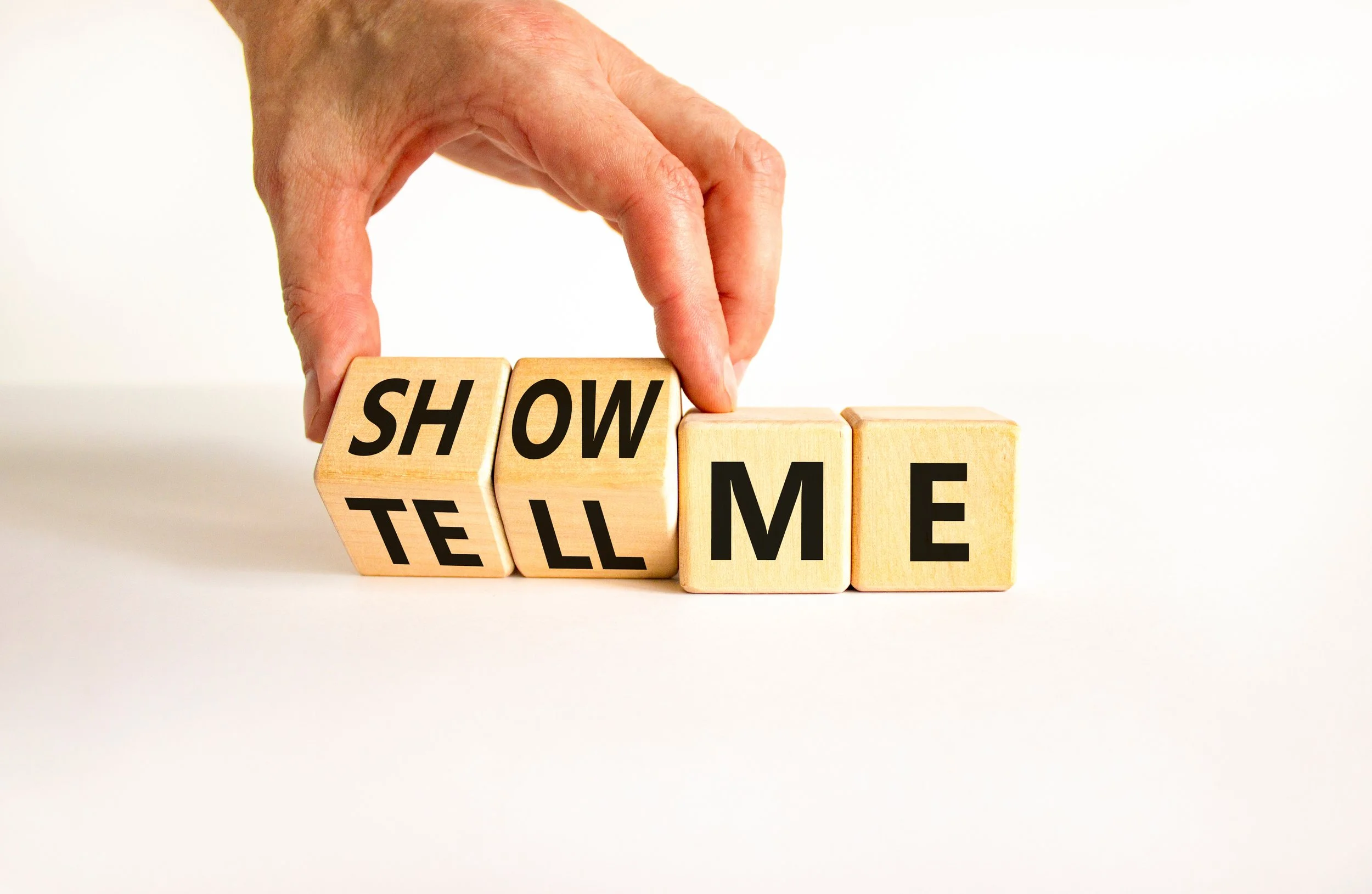
The old writing adage “show don’t tell” must go. It’s simplistic and misleading.
Showing is not automatically better. Indeed, the tyrannical dictum of “showing” leads commercial and literary writers alike to believe that the power of story lies mainly, if not entirely, in what readers can visualize. If we can “see” it, then it must have meaning and emotional force.
That is rarely if ever true.
Which is not to say that visualizing is unimportant. The type of imagination used by readers to bring story alive in the mind and heart has two triggers: visual cues, yes, but also emotional cues.
The visual part does matter, and it’s not just visual. All sensory cues (sight, sound, taste, touch, smell) when present on the page send readers searching their experiential memory banks for reference. Readers can “hear” the toll of a church bell, or “smell” the pungent, earthy odor of a horse barn, experience of which they’ve had either directly or second hand.
As a story unfolds, we “see” its action—the slow lifting of a spoon, say—and so the story seems to us real. That’s fine, but as I said that is only one half of what triggers story imagination. The other half is emotional cues. As we read, we are presented with signals to feel. It would seem, then that simply reporting what characters are feeling would fulfill the requirement, but that also is wrong.
As I explained in The Emotional Craft of Fiction, psychological research shows us that readers do not feel what characters are feeling. Not at all. Not even a little bit. Readers are on their own emotional journeys through a story, constantly searching their emotional memory banks for experiences that are analogous to—like—the one reported on the page. Readers find those and “get” the emotion, except that what they “get” is not a character’s feeling but their own.
And even that is incomplete. Readers “get” an emotional moment in a story only when they have to work for it. Force feeding “hope” or “fear” on the page doesn’t work. Evoking a feeling in the reader does.
Which brings us to the practical side of telling. If showing is flat, nor does reporting emotions get readers to feel anything, what does? Is there anything that evokes a moment better than pure showing or telling?
The Third Way
Let’s get at it through a challenging example, something low tension and undramatic, maybe even dull.
Suppose that a group of friends is unpacking picnic baskets by the side of a lake. How’s that for undramatic and dull? Let’s say that the friends have not been together for a while. What we want to get across is the combination of both familiarity and awkwardness that attends this moment. The friends might fall into familiar and superficial patterns, avoiding at first the harder business of renewing their connections.
The purely visual approach, which we might find in rigorously opaque literary writing, would read something like this:
Daphne carried the picnic baskets from the back of her hatch-back, its rear door plastered with pro-Palestinian slogans and stickers of whales. Paul delivered from his Lexus bottles of Chardonnay in insulated sleeves. We spread blankets and set out plastic utensils. Daphne had brough her own forks and spoons made of recycled wood. Paul twisted open the cap of the first bottle, rolled up the sleeves of his dress shirt and began to pour.
What do we think? The details are telling. Daphne with her virtue-signaling hatch-back and wooden reusable utensils is obviously one kind of person. Paul with his Lexus and contribution of wine is clearly another. Tensions in the group may be implied, hints of personality gleaned.
There is a deft selection of details, then, but note that the passage is wholly visual. As yet, nothing has “happened”, true, this is only beginning of the picnic, but through the contrasts presented we are intended to feel the tension of the moment. We “see” and that is supposed to make this picnic prep pregnant with meaning.
Is it? Are we keenly anticipating? To what degree? Any at all? Let’s try the same thing but with emphasis on telling:
Daphne as ever was prepared to change the world one picnic basket at a time. She bore them from her hatch-back as if potato salad was a weapon. We spread out the picnic blankets cautiously. As Paul strolled from his Lexus, screw-cap bottles of Chardonnay in both fists, we braced for the old shootout. We could count on it. What was supposed to be a reunion probably was going to be more like a rumble.
What do we think? Using that approach, the writer is putting front and center the felt tension. Details of potato salad and Chardonnay a mere nod to visual showing. We are told to brace for a clash of personalities, if not politics. Is telling more effective? Are we feeling the mild dread that the friends, we are assured, are feeling?
If you ask me, not much. What we are supposed to feel is spoon fed to us, and therefore the effect is less than hoped. There is no discovery and therefore the impact on us is mild. We have a vague sense of the moment but not a strong experience of it.
What would produce that instead? Let’s try an approach that is neither dryly visual nor smacking the moment’s feeling on the nose:
Unpacking Daphne’s hatch-back and Paul’s Lexus kept us busy, so that we didn’t have to unpack what wasn’t being said. The whale stickers on Daphne’s rear bumper were faded, but the pro-Palestinian slogans were new. Paul carried bottles of Chardonnay in each fist, gunslinger style, but the bottles were screw-cap. The urgency and fire of our collage days had cooled like embers. We were older now.
Better? The emotional effect is less obvious, a little more mellow, anchored less in the past and more in the present. There’s past-present contrast too. The tension in play isn’t anticipation of old conflicts, but sadness that those former days are fading. Ask me, there’s a bit more surprise in this version. It’s less forced, more natural. Still, the moment is static. It defines the moment but doesn’t move it forward.
Let’s try to keep the same approach but add to it something dynamic, meaning not just pinning the moment like a dead butterfly to a board, but foretelling change. Maybe something like…
Daphne carried picnic baskets from her sticker-strewn hatch-back. Paul brought wine from his Lexus. We spread picnic blankets on the grass, making common ground. The urgency and fire of our undergraduate days had cooled. We were older now. The talk would be less about 86-47 and more about 401K’s.
Was that really what we had become? Ex-firebrands consuming potato salad and screw-cap Chardonnay?
We looked at each other, sitting cross-legged and cool in shorts and summer dresses, plastic wine glasses held like unlit candles, waiting for one of us—anyone—to strike a match and save us.
Better? Maybe, but it’s still largely static, more a moment—visual and vivid as it may be—that’s stuck in time, not yet moving forward. Let’s add something. Keeping the first paragraph the same, how about…
Was that really what we had become? Ex-firebrands consuming potato salad and screw-cap Chardonnay?
We looked at each other, sitting cross-legged and cool in shorts and summer dresses, plastic wine glasses held like unlit candles, waiting for Daphne to strike the match that would save us.
But it was neither Daphne nor Paul who kindled the old fire. It was Dan: quiet, non-committal Dan.
“So, who else thinks this is pathetic?” he said.
Now the moment is not sitting squat but moving ahead. There are things to visualize, imagery to chew on, an unsatisfying feeling, and a sense that the situation is going somewhere. What technique is the final version relying on, showing or telling?
I would say neither: It is relying on capturing an instant of experience with immersive POV, meaning not just giving visual details, or reporting emotions, but pulling together on a picnic blanket both sadness, hope and change—the whole range of the experience of dwelling in this sad and nostalgic couple of minutes, as well as leaning toward what’s coming in the couple of minutes that will follow.
Surprise and the Whole Experience
Every page is a story moment. There are choices. You can caution yourself—show don’t tell—and hope that the reader senses under the visible surface something meaningful. Or, you can spoon out that meaning unmissably to readers, thereby leaving readers nothing to experience for themselves.
So, you can write a moment in such a way that the whole essence of it is captured: what we see, what we feel, the longing that we sense, the truth we know is lurking around, and a change underway that tells us this moment isn’t just a frozen, it’s a micro-step in a story.
If you think of story steps as plot events, that’s fine but you’re only looking at giant leaps, which do not occur on every page. In between there is this moment, then that moment, all of the unique minutes that make up every scene. And there at least as many of those moments as there are pages in your manuscript, correct?
So, how do you handle them? Obeying the tyranny of show don’t tell? Dutifully reporting feelings that are obvious and robbing the reader of their own discoveries? Or, will you write those many moments like each one is a whole story unto itself, complete with conflict, a twist or turn, and surprises—from new perspectives to fresh language—for the reader to discover and process.
Show don’t tell must go. However, telling alone isn’t the answer either. Micro-moments are the most effective when you write the hell out of them, treating them like they are the last words the reader will ever read.
What story value do you regard as paramount, showing or telling? Which authors do you find transcend those?
For more on this topic, you might be interested in THE SHOW-TELL SOLUTION webinar, featuring Don Maass and Lorin Oberweger, available on our recordings page!